
The human brain evolved to keep our ancestors alive on African savannas, where split-second threat detection meant survival and false alarms were preferable to missed dangers. But in modern life, this ancient alarm system misfires constantly, triggering full-blown panic responses to situations that pose zero actual danger. These aren’t character flaws or mental weakness—they’re evolutionary features that haven’t caught up to civilization, creating genuine suffering over imaginary threats your rational mind knows aren’t real but your body can’t distinguish from mortal peril.
1. Social Rejection Activates the Same Pain Circuits as Physical Injury

Your brain processes social rejection—being excluded from a group, not getting a text back, seeing friends together without you—using the exact same neural pathways that process physical pain. An unanswered message or being left out of plans triggers the anterior cingulate cortex and insula, just like breaking a bone, creating genuine distress over something that poses zero threat to your survival. Your body releases stress hormones, your heart rate increases, and you experience real suffering because your brain genuinely can’t distinguish between social exclusion and physical danger.
The evolutionary logic made sense when banishment from the tribe meant death, but now your brain panics over minor social slights as if your life depends on them. Being ghosted after a date, not being invited to a party, or having a friend cancel plans triggers the same threat response as predator attacks triggered in ancestors. You rationally know a cancelled lunch won’t kill you, but your amygdala doesn’t care—it’s screaming that isolation equals death, flooding your system with cortisol and adrenaline for a threat that exists only in a social context.
2. Uncertainty Triggers Stronger Fear Than Guaranteed Bad Outcomes

Your brain would rather face a certain negative outcome than endure uncertainty, creating panic over “not knowing” that exceeds the actual worst-case scenario. Waiting for medical test results creates more anxiety than receiving bad news, because uncertainty activates sustained threat response, while known bad news at least allows planning. Studies show people experience more stress from a 50% chance of electric shock than froma guaranteed shock, because the brain can’t prepare for uncertain threats and interprets this inability as maximum danger.
This manifests in relationship anxiety where “does he like me?” creates more distress than “he definitely doesn’t,” career paralysis where waiting for job news is worse than rejection, and medical panic where “it could be cancer” triggers more fear than “it is cancer.” Your brain treats uncertainty as the worst possible threat because evolutionary survival required immediate threat assessment and response. Modern life creates constant uncertainty—job security, relationship status, financial futures—and your brain panics continuously over these unknowns as if they’re immediate mortal dangers requiring a fight-or-flight response.
3. Public Speaking Activates Ancient Predator-Detection Systems

Standing in front of a group while being watched triggers the exact brain circuits that detected predators watching from bushes, creating terror so intense that public speaking consistently ranks as a greater fear than death. When all eyes turn to you, your amygdala interprets being watched by many individuals as the threat pattern of being surrounded by predators. Your brain floods with adrenaline, your heart pounds, your hands shake, and you experience genuine panic—not because speaking is dangerous, but because being the visual focus of many sets of eyes meant imminent attack to your ancestors.
The physical symptoms—dry mouth, racing heart, trembling, nausea—are your body preparing to fight or flee predators that don’t exist. Your rational cortex knows the audience won’t attack, but your limbic system is screaming that you’re surrounded and in mortal danger. No amount of logic stops the panic because the threat detection system operates below conscious control. Thousands of years of public speaking experience as a species can’t override millions of years of evolution that says “many eyes watching you = danger.”
4. Heights Trigger Vertigo Even Behind Safety Barriers

Your brain creates the sensation of falling and overwhelming fear of heights even when you’re completely safe behind barriers or glass walls, because it can’t process that modern safety measures actually work. Standing on a glass floor observation deck triggers the same terror as standing on a cliff edge, with your brain interpreting visual height signals as immediate fall danger despite knowing rationally that the floor is solid. The disconnect between what your eyes see (a dangerous drop) and what your body experiences (a safe, solid surface) creates vertigo and panic.
This isn’t fear of heights—it’s your brain’s inability to trust that human-made safety measures override gravity. Your visual system reports “long fall possible,” and your threat detection activates regardless of barriers, railings, or solid glass. Some people experience the bizarre urge to jump from safe heights (high place phenomenon), which is actually your brain testing whether you’re going to act on the false danger signal it’s sending. The height panic is your prehistoric brain rejecting the concept of engineered safety because safe high places didn’t exist in evolutionary history.
5. Flying Triggers Panic Despite Being Statistically Safest Travel

Your brain creates intense fear of flying despite knowing rationally that it’s safer than driving, because your threat detection system can’t process that being in a metal tube at 30,000 feet is actually low-risk. Every bump of turbulence triggers panic because your brain has no context for “normal movement while flying”—all movement that feels like falling triggers danger signals. You’re consciously aware of safety statistics, but your amygdala is screaming that being this high with no ground contact violates every survival rule.
The panic is compounded by lack of control—you’re not flying the plane, you can’t see what’s happening, and you’re trapped in a tube you can’t escape. Your brain interprets a lack of control as maximum vulnerability, triggering sustained fight-or-flight despite no actual threat. The sounds, sensations, and confinement of flying trigger claustrophobia and danger responses that statistics can’t override because your threat system doesn’t process statistical risk—it processes immediate sensory input that says “this is wrong and dangerous.”
6. Darkness Activates Predator-Vigilance Overdrive

Darkness triggers hypervigilance and anxiety because your brain assumes that the inability to see means hidden predators, even in your bedroom or familiar spaces. Your threat detection system evolved when darkness genuinely meant maximum vulnerability to nocturnal predators, so it activates heightened alert status automatically when vision is compromised. Every sound becomes magnified, shadows become threats, and your imagination creates dangers that your rational mind knows don’t exist.
The panic manifests as racing thoughts, hypervigilance, interpretation of every noise as a threat, and inability to relax despite being in objectively safe spaces. Your brain essentially says “if I can’t see it, I must assume maximum danger,” because this false positive kept ancestors alive. Modern humans are evolutionarily identical to ancestors who were legitimately threatened by darkness, so our brains still panic in dark bedrooms, parking garages, and nighttime walks as if predators are guaranteed rather than impossible.
7. Unfamiliar Sounds at Night Create Certainty of Danger
Your brain interprets any unfamiliar nighttime sound as a definite threat, creating panic and certainty that someone is breaking in or something is wrong, even when the sound is mundane, such as the house settling or animals. The combination of darkness (reduced vision) plus unexpected sound equals maximum threat activation, flooding your body with adrenaline and creating the absolute conviction that danger is present. Your rational mind knows it’s probably nothing, but your body is already in fight-or-flight before conscious processing occurs.
This manifests as lying awake convinced someone is in your house, being certain the furnace noise means mechanical failure, or interpreting animal sounds as intruders. Your brain can’t process “probably harmless” during nighttime acoustic events—it defaults to “definitely threat” because the survival cost of false negatives (ignoring real danger) was death while false positives (panicking over nothing) cost only sleep. You’ve inherited a brain that chooses panic over every nighttime sound rather than risk missing one actual threat.
8. Perceived Surveillance Triggers Paranoia Even When Irrational

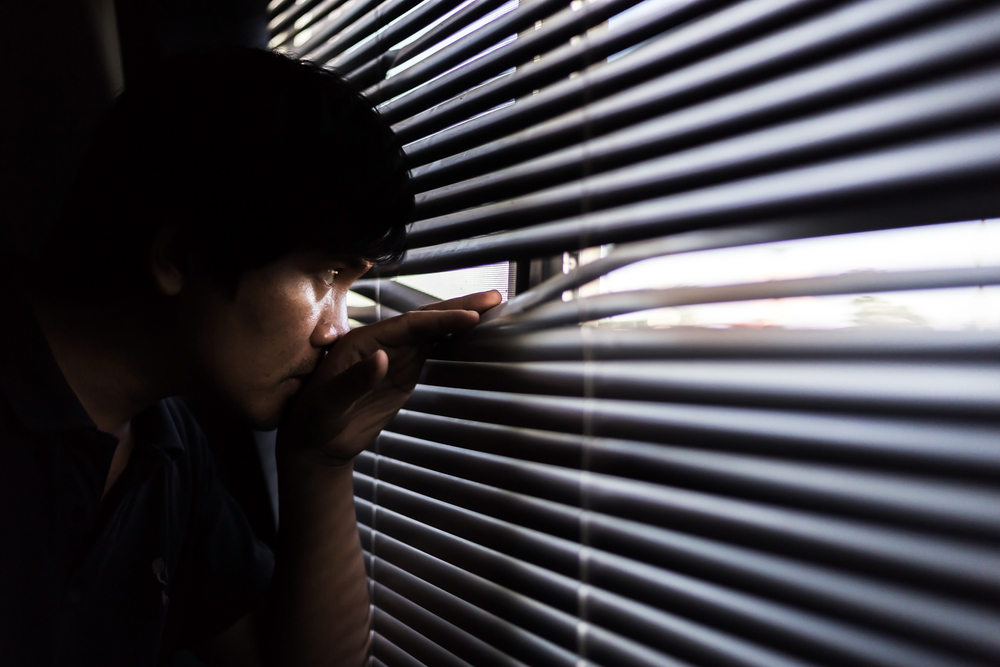
Your brain interprets the feeling of being watched—even when you know you’re not—as a legitimate threat, creating paranoia and anxiety in situations where you’re objectively alone or safe. The sensation that someone is watching triggers the same circuits that detected actual surveillance by predators or enemies, flooding you with cortisol despite knowing logically that no one is there. This evolved because being watched often preceded attack, so your brain developed hair-trigger sensitivity to surveillance cues, real or imagined.
Modern manifestations include anxiety about security cameras, social media monitoring fears, and the feeling that someone is watching through windows or following you. Your rational brain knows that most surveillance is benign or imaginary, but your threat system treats all surveillance as hostile intent. The discomfort of being watched—in meetings, on camera, or even the illusory sense of eyes on you—creates genuine distress because your brain can’t distinguish between being monitored by cameras and being stalked by predators.
9. Approaching Deadlines Create Survival-Level Stress

Your brain processes approaching deadlines as genuine threats to survival, creating panic, stress hormones, and physical symptoms identical to facing actual danger. A work deadline or exam triggers the hypothalamic-pituitary-adrenal axis, flooding your system with cortisol and creating the same physiological state as escaping a predator. Your body can’t distinguish between “report due Friday” and “lion chasing you now”—both create deadline pressure that feels like life-or-death urgency.
The procrastination-panic cycle exists because your brain doesn’t activate threat response for distant deadlines—the danger isn’t “now” so threat systems don’t engage. As deadlines approach, the time pressure finally triggers an emergency response, creating the focus and energy needed to complete tasks but at enormous physical and psychological cost. You experience genuine panic, racing heart, tunnel vision, and stress response over missing deadlines that pose zero actual threat to your survival, but your brain treats them as mortal emergencies requiring maximum physiological activation.
10. Social Media Notifications Hijack Threat-Detection Systems

Your brain treats social media notifications—likes, comments, messages—as social threat or acceptance signals, creating anxiety and compulsive checking behavior. The uncertainty of “what will the notification say?” triggers the same circuits as uncertain threats, while lack of notifications triggers social rejection pain circuits. Your brain can’t process that Instagram likes aren’t actual social standing, so it treats each notification as information about your tribal status and safety within the group.
The compulsive checking is your brain trying to resolve uncertainty that it perceives as threat-related. Each phone check is a threat assessment—”am I safe in my social group?”—that temporarily resolves anxiety but creates dependence on continuous reassurance. Your brain developed to track social standing within a group of 50-150 people, but now it’s trying to track status across hundreds or thousands of social media connections, creating sustained anxiety and panic over social signals that don’t actually impact your survival.
11. Phone Calls Trigger Fight-or-Flight in a Way Texts Don’t

Unexpected phone calls create anxiety and fear that texts don’t, because your brain interprets phone calls as requiring immediate response to a potential emergency. The ringing phone triggers “something urgent needs immediate attention” circuits, flooding you with adrenaline before you even know who’s calling or why. Your rational mind knows it’s probably not an emergency, but your body activates threat response because historically, situations requiring immediate attention were usually threats or crises.
Modern brains have adapted to text communication, where you can control response timing, making unexpected phone calls feel like ambushes requiring immediate fight-or-flight decisions. The anxiety about answering calls from unknown numbers or even familiar contacts stems from uncertainty (what do they want?) plus demand for immediate engagement—a combination your brain processes as potential threat requiring maximum alertness. You experience genuine panic over phone calls despite knowing logically that they’re just communication, because your threat system can’t distinguish between “immediate attention required” for calls versus actual emergencies.
12. Silence and Stillness Feel More Threatening Than Noise

Complete silence triggers anxiety and hypervigilance because your brain interprets lack of ambient sound as “something is wrong”—predators nearby, danger forcing everything else to quiet down. Your threat detection system expects environmental noise and movement, using these as “all clear” signals that life is proceeding normally. When silence occurs, especially sudden silence, your brain assumes danger has arrived, and everything else is hiding or fleeing.
This manifests as an inability to relax in very quiet places, discomfort with silence in conversations, and anxiety in still environments. Your brain treats silence as “the calm before the attack,” activating vigilance and stress response despite being in objectively safe situations. Many people need white noise or background sound to sleep or feel comfortable because their brains interpret silence as a maximum threat condition. The evolutionary logic was sound—when forests went silent, predators were near—but modern brains panic in quiet offices, silent homes, or peaceful environments because the threat detection system hasn’t updated for thousands of years.